
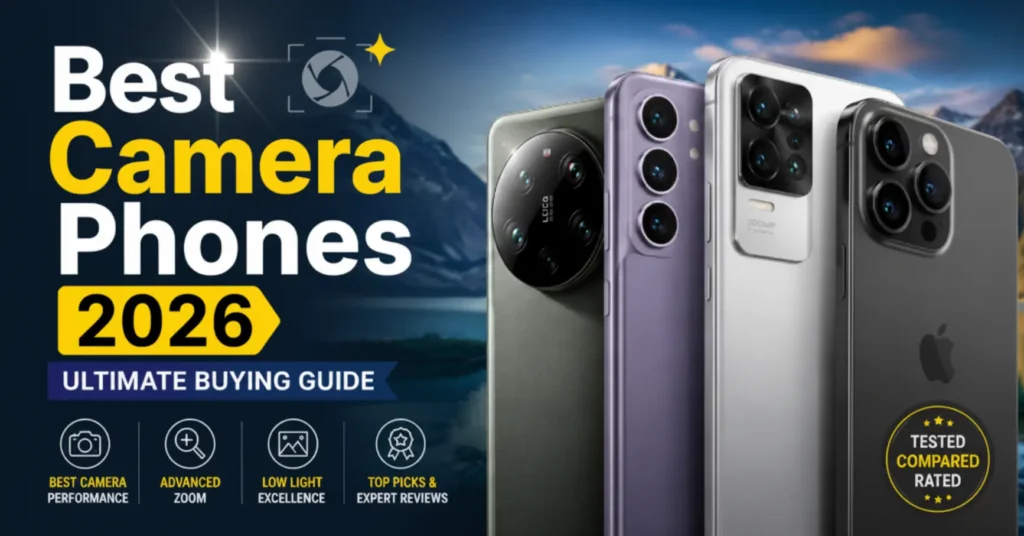
Best Camera Phones 2026: Ultimate Buying Guide
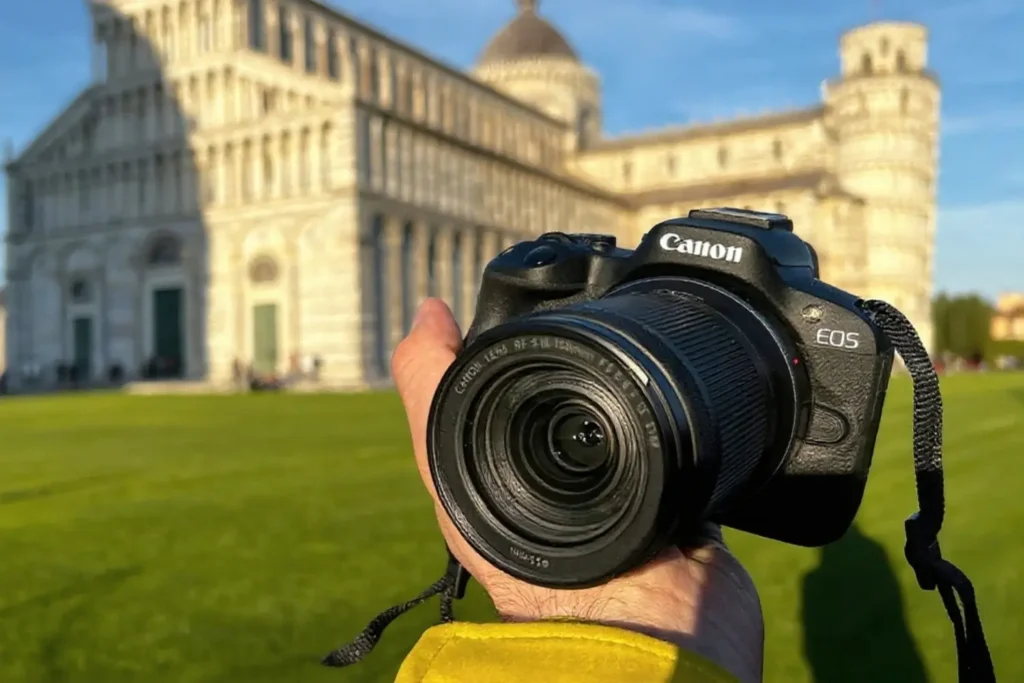
Smartphones in 2026 have blurred the line between dedicated cameras and pocket devices. Thanks to massive sensor improvements, refined optics, advanced computational imaging, and AI‑driven processing, camera phones now rival entry‑level mirrorless systems for everyday and creative photography.
The best smartphones for photographers in 2026 offer advanced camera systems, AI-powered photography, and exceptional image quality. From stunning low-light performance to professional-grade zoom and video recording, today’s flagship phones can rival dedicated cameras.
How Camera Phones Are Judged in 2026
To understand why some phones outperform others, we must look beyond megapixels. Today’s phones combine hardware and software to deliver meaningful photographic improvements.
Core Camera Evaluation Criteria
Bigger sensors capture cleaner images in dark scenes.
Quality lenses with OIS (optical image stabilization) improve sharpness and reduce motion blur.
True optical zoom (telephoto/periscope) gives sharper long‑range shots than digital interpolation.
AI HDR, sky replacement, noise reduction, and scene optimization drive image quality.
Bitrate, frame rates (e.g., 4K 60 fps, 8K), and stabilization matter to creators.
Easy automatic modes plus manual controls satisfy both beginners and pros.
Modern camera benchmarks (e.g., DXOMark) evaluate photo, zoom, and video scores to reflect real performance, not spec sheets alone.
The Best Camera Phones of 2026: Definitive Ranking
Experts from multiple testing labs and review outlets agree: 2026 is one of the most competitive years yet for smartphone imaging. Here are the standout performers across real use cases.
Unmatched All‑Around Imaging

Apple iPhone 17 Pro Max
Universally celebrated for color science, video prowess, and exposure consistency, this device remains a top pick for photographers and storytellers alike. It excels in dynamic range, skin tones, and multi‑lighting conditions — especially for people and travel photography.
Key reasons to choose:
This model’s integration with the iOS ecosystem and accessory support (gimbals, external mics) cements its lead for creators and professionals.
Most Powerful Zoom and Telephoto
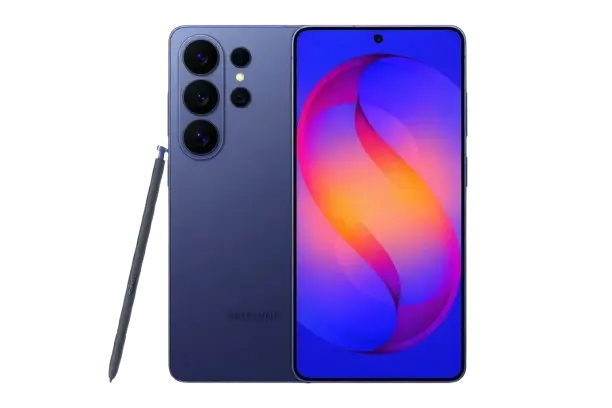
Samsung Galaxy S26 Ultra
Samsung’s flagship Android camera delivers flexibility with a 200 MP main sensor and advanced multi‑focal telephoto options. It’s especially compelling for architecture, sports, wildlife, and travel photography.
Photography strengths:
Samsung’s rich camera toolkit allows both novice and seasoned photographers to experiment with modes seldom found outside pro gear.
Best Computational and AI‑Driven Photography
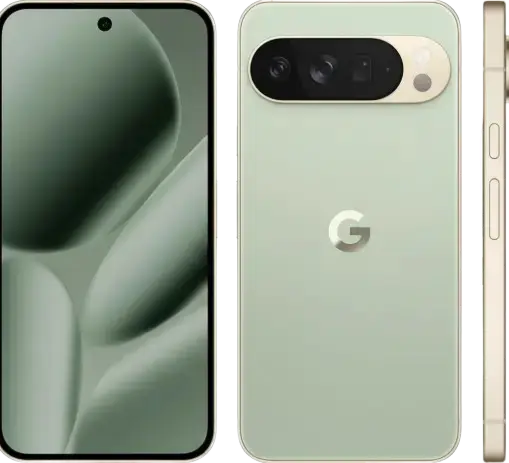
Google Pixel 10 Pro
Google continues to refine ‘computational camera first’ philosophy. With smart HDR, excellent dynamic range, and intuitive editing tools, this phone provides simple point‑and‑shoot excellence that often surprises even experienced photographers.
Why it shines:
If you value ease of use and minimal post‑processing work, Google’s Pixel holds a strong edge.
Deep Dive: Flagship Camera Concepts Compared
Rather than repeat list headings, here’s how each device competes across major photographic disciplines.
Daylight and Everyday Shoots
For general use — landscapes, street scenes, family photos, pets — consistency is king. Phones like the iPhone 17 Pro Max, Pixel 10 Pro, and Samsung S26 Ultra deliver dependable results across a range of lighting conditions with minimal manual tweaking.
Google excels in clean captures with computational balance, while Apple and Samsung handle highlights and color transitions impressively.
Portrait Photography
Portrait imaging tests the camera’s ability to handle skin tones, depth mapping, and edge detection. Apple’s tuning excels at natural skin tones and background separation, especially in mixed light. Samsung’s telephoto lenses offer artistic compression for flattering portraits at longer focal lengths.

Pixel 10 Pro delivers accurate depth with subtle edge definition, making it ideal for social posts and casual portraits.
Low‑Light and Night Scenes
Low‑light shooting remains a battleground. Phones with larger sensors and advanced night modes — such as the Xiaomi 17 Ultra with its 1‑inch sensor, and Samsung’s flagship systems — produce cleaner, more detailed shots in low illumination.
AI noise reduction and multi‑frame stacking now let even mid‑range models hold their own, though flagship hardware still leads in true night performance.
Zoom Performance
Optical zoom delivers superior results compared with digital zoom or cropping. Devices like the Samsung S26 Ultra and Oppo Find X9 Ultra provide extended reach that rivals traditional optics — a huge advantage for travel, wildlife, and distant scenes.
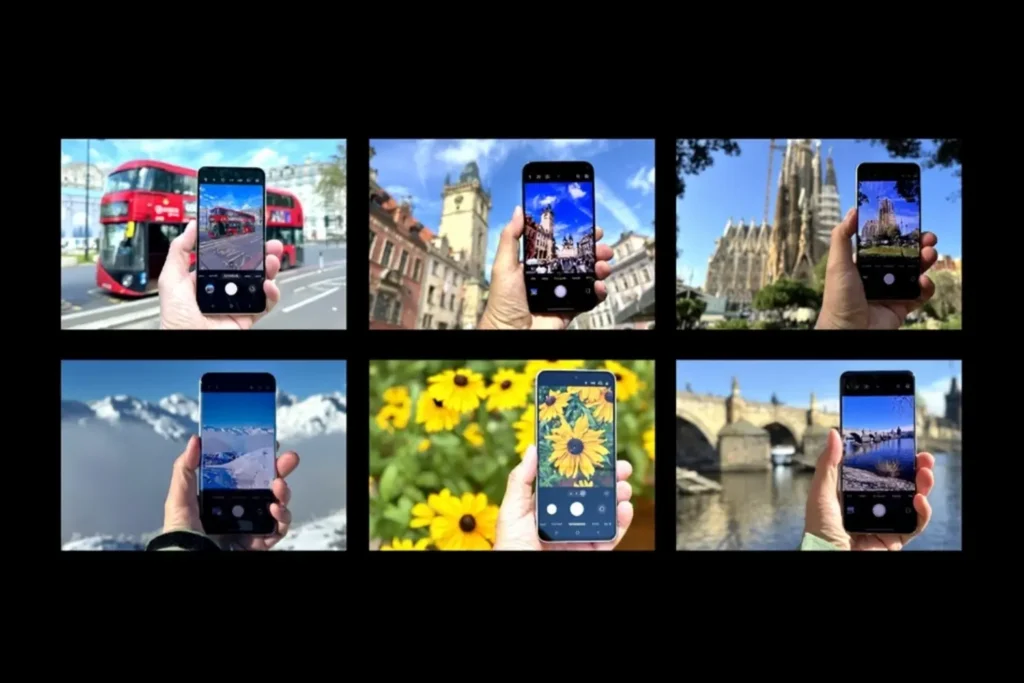
Phones with periscope lenses are especially adept at retaining detail beyond 5× magnification.
Professional Video Needs
For creators focused on video, stabilization, codec support, and frame rate matter. Apple leads with smooth color transitions, strong stabilization, and high‑bitrate formats — while Android challengers like vivo and Xiaomi bring advanced logging profiles and high frame‑rate options.
Video tools such as Dolby Vision, 10‑bit color, and manual exposure controls are increasingly common in flagship models.
Mid‑Range Options That Punch Above Their Price
Aside from top‑tier flagships, several mid‑range phones in 2026 deliver surprisingly strong camera results without flagship pricing pressure.
Google Pixel 10a:
Impressive AI computational photography and balanced low‑light stills.
Samsung Galaxy A‑series models: Consistent everyday photography and strong night performance.
Xiaomi 15T Pro:
Leverages flagship‑grade sensors and tuning for exceptional value.
For users on a budget, the main camera quality and reliable processing matter more than extra auxiliary lenses that rarely get used.
Choosing the Right Camera Phone for Your Purpose
Here’s a practical decision guide based on your shooting style — without redundant headings but with quantifiable differences.
If you want simple, amazing everyday photos:
Pick devices that emphasize balanced color, automated scene tuning, and quick point‑and‑shoot ease: Apple and Pixel models excel here.
If you shoot sports or travel photos:
Look for extended zoom capability and stabilization; high‑resolution periscopes on Samsung and Oppo provide extended reach.
If you prioritize manual control and editing:
Phones with manual modes, RAW capture, and advanced color profiles (e.g., Leica‑tuned systems on Xiaomi) make editing workflows more expressive.
If video content is your goal:
Choose models with professional video options, strong stabilization, and wider codec support — Apple and Android flagships lead here.
Why Megapixels Aren’t Everything
Across all major reviews and field tests, there’s a consistent refrain: megapixels alone don’t define image quality. Larger sensors, better optics, and smarter processing outperform pure resolution metrics.
Phones with lower pixel counts but superior sensor size and lens quality often produce more natural and detailed photos — especially in dynamic lighting.
Pros and Cons of Smartphone Photography in 2026
PROS
CONS
Final Recommendation: What to Buy in 2026
Apple iPhone 17 Pro Max — balance of photo, video, and consistency.
Samsung Galaxy S26 Ultra — flexible shooting modes and zoom excellence.
Google Pixel 10 Pro — easy and polished everyday imaging.
Xiaomi 17 Ultra — largest sensor and creative control.
Google Pixel 10a or Xiaomi 15T Pro — flagship‑grade camera tech at reasonable cost.
Camera phones in 2026 are incredibly capable — but the best choice always aligns with your photo needs, creative goals, and budget.
Why Smartphone Cameras Matter More Than Ever in 2026
Smartphone cameras matter more in 2026 because people now use one device for travel photos, family memories, social media posts, business content, vlogs, and even semi-professional shoots. Modern phones combine large sensors, AI image processing, improved stabilization, optical zoom, and instant editing tools, making them more practical than carrying a separate camera for daily use.
For most users, the best camera phone is not only about sharp photos; it is about speed, reliability, natural colors, strong video, and how easily the phone captures a great shot in real life.
What Actually Makes a Smartphone Camera Great?
A great smartphone camera depends on sensor size, lens quality, optical image stabilization, autofocus, dynamic range, night mode, zoom performance, and software processing. Megapixels can help with detail and cropping, but they do not guarantee better photos by themselves.
A phone with balanced processing, clean low-light results, accurate skin tones, and stable video often performs better than a phone that only advertises a high-resolution sensor. In 2026, AI also plays a major role by improving exposure, removing blur, reducing noise, and making photos easier to edit.
Best Overall Camera Phones You Can Buy This Year
The best overall camera phones in 2026 are the models that perform well across photos, video, portraits, zoom, selfies, and low-light shooting.
The iPhone 17 Pro Max is a top choice for users who want consistent results with minimal effort, while the Samsung Galaxy S26 Ultra is ideal for people who want more zoom range and Android flexibility.
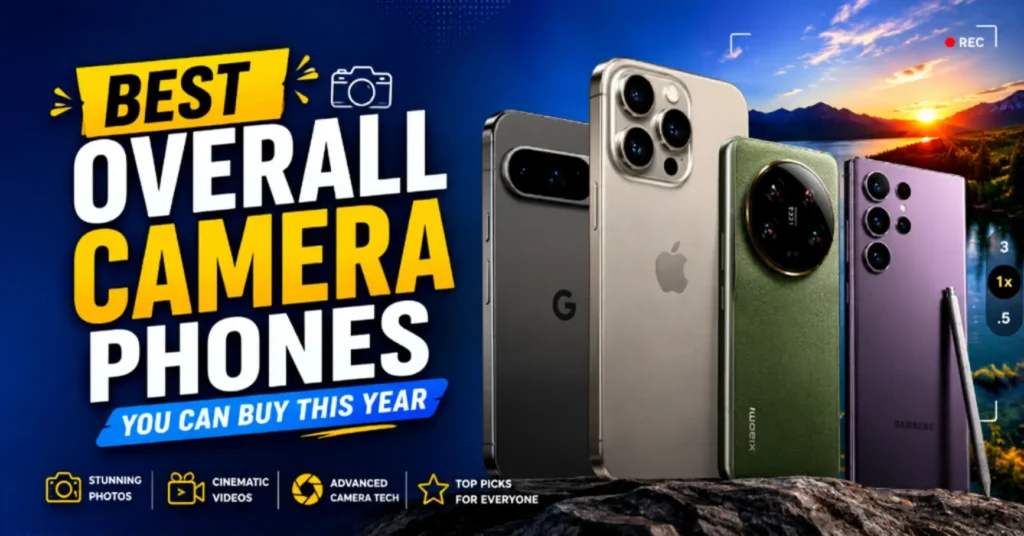
Google Pixel 10 Pro is excellent for AI-assisted photography, and Xiaomi, Vivo, and Oppo flagships are strong choices for users who want more advanced camera hardware and creative control.
iPhone vs Android Cameras: Which One Fits Your Style?
iPhone cameras are best for users who want natural-looking images, smooth video, simple controls, and reliable results in almost every situation. Android camera phones offer more variety, with Samsung focusing on zoom and features, Google leading in AI photography, and Xiaomi, Vivo, and Oppo offering advanced sensors, manual controls, and unique color tuning.
If you want easy point-and-shoot results, iPhone or Pixel may suit you better. If you enjoy experimenting with zoom, RAW files, manual settings, and creative modes, Android gives you more flexibility.
The Top Smartphones for Professional Photography
Professional-style smartphone photography requires more than automatic shooting. Phones such as Xiaomi Ultra models, Vivo Ultra models, Oppo Find Ultra models, iPhone Pro models, and Samsung Ultra models give creators stronger tools for RAW capture, telephoto portraits, manual exposure, color profiles, and high-resolution editing.
These phones are useful for travel photographers, product creators, social media professionals, and mobile content makers who want more control over lighting, framing, depth, and final image style.
Best Camera Phones for Social Media Creators and Vloggers
For social media creators and vloggers, the Best phone should offer strong front and rear cameras, stable video, good microphones, fast autofocus, and reliable performance in changing light.
The iPhone 17 Pro Max is a strong choice for creators because of its smooth video quality and app-friendly workflow.
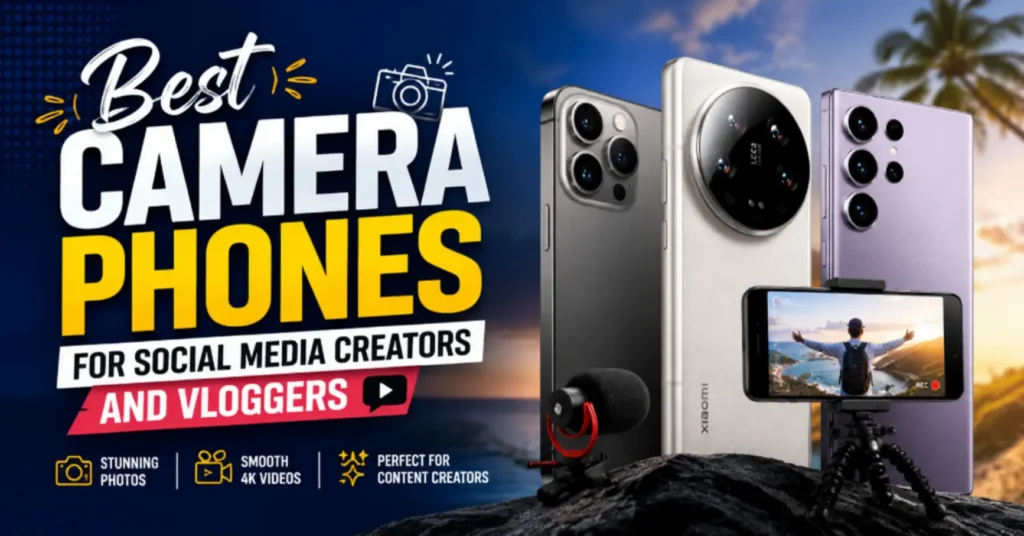
Vivo and Samsung flagships are excellent for users who want advanced video modes, while Google Pixel phones are helpful for quick AI edits and share-ready photos.
Storage is also important because 4K video, high-resolution images, and short-form content can fill space quickly.
Which Smartphones Deliver the Best Zoom and Telephoto Shots?
The best zoom camera phones use real telephoto or periscope lenses rather than relying solely on digital zoom. Samsung Galaxy Ultra models are especially strong for long-range shots, making them useful for concerts, sports, wildlife, architecture, and travel photography.
Oppo and Xiaomi Ultra phones also offer impressive telephoto performance with strong detail and creative focal lengths. For portraits, a good telephoto lens helps create natural background separation and a more flattering look than a wide main camera.
Low-Light and Night Photography: Phones That Perform Best After Dark
Low-light camera performance depends on sensor size, stabilization, aperture, night mode, and image processing. Phones with larger sensors and advanced night algorithms can capture brighter images with less blur and noise.



Xiaomi Ultra models are strong for camera-like night shots, while iPhone, Pixel, Samsung, Vivo, and Oppo flagships use powerful processing to improve dark scenes.
For real-life use, the best low-light phone should keep people’s faces natural, avoid over-brightening the scene, and preserve detail without making the photo look artificial.
Budget-Friendly Camera Phones That Still Take Amazing Photos
Budget and mid-range camera phones are much better in 2026 than they used to be. Devices like Xiaomi T-series models, Google Pixel A-series phones, Samsung Galaxy A-series phones, and selected Motorola Edge models can take sharp, colorful, social-media-ready photos at a lower price.
When buying a cheaper camera phone, focus on the main camera quality instead of being impressed by extra weak lenses. A strong main sensor with good processing is usually more useful than a phone with multiple low-quality cameras.
How to Choose the Right Camera Phone for Your Photography Needs
The right camera phone depends on what you shoot most. Choose iPhone or Pixel if you want simple, reliable photos with little editing. Choose Samsung if you care about zoom, extra modes, and a feature-rich camera app. Choose Xiaomi, Vivo, or Oppo if you enjoy manual controls, large sensors, creative color styles, and advanced video tools.
Also consider storage, battery life, screen brightness, software support, and price. The best camera phone is not always the most expensive one; it is the phone that matches your shooting style, budget, and daily needs.
Frequently Asked Questions (FAQs)
CONCLUSION
The best camera phone in 2026 depends on your priorities. For most users, the iPhone 17 Pro Max strikes the perfect balance between photo quality, video capability, and user-friendly operation. If zoom, feature-rich controls, or AI-enhanced imaging are essential, Samsung, Google, Xiaomi, Vivo, and Oppo offer specialized alternatives that match those needs.
Mid-range options like the Xiaomi 15T Pro or Pixel A-series phones now deliver strong results for casual photographers and social media users without breaking the bank. Ultimately, the “best” camera phone is not determined by megapixel count alone — it’s the combination of sensor size, lens quality, computational photography, video tools, and user workflow.
Choose a device that complements your shooting style, budget, and creative ambitions, and you’ll have a pocket-sized studio that rivals traditional cameras.