Camera vs Phone 2026: Which Should You Buy
Camera vs Phone 2026: Which Should You Buy
If you only take photos for social media, family memories, travel, food, and quick videos, a good smartphone is enough for most people in 2026. Modern phones use powerful AI and computational photography to make photos look bright, sharp, and ready to share with very little effort.
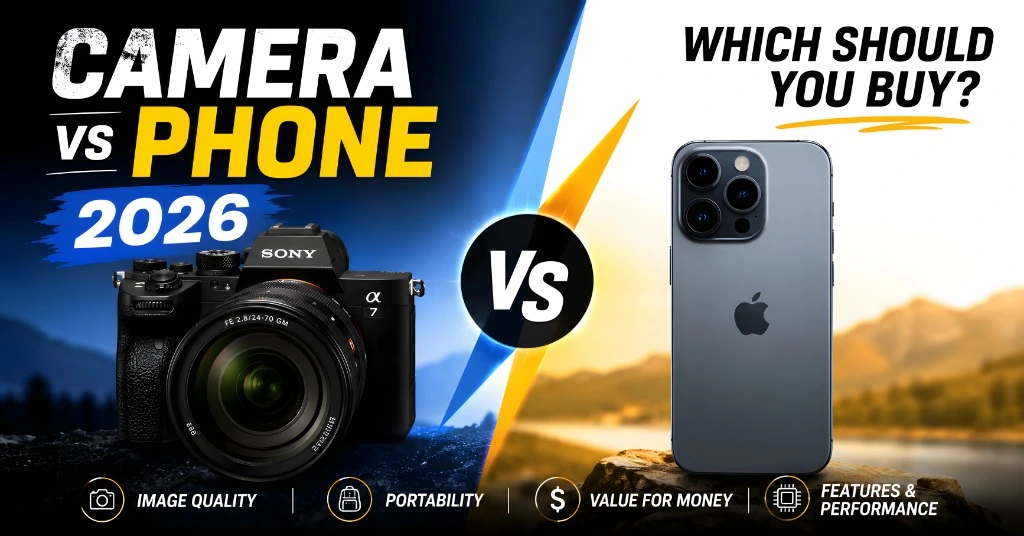
But if you want better low-light quality, real background blur, long zoom, professional portraits, wildlife photos, sports shots, or serious YouTube work, a dedicated camera is still worth buying. A mirrorless camera offers a larger sensor, better lens options, more manual control, and more room to grow.
Camera or Phone in 2026?
In 2026, phones are great for quick photos, social media, travel memories, and everyday videos. But a camera is still better if you want stronger image quality, better zoom, low-light performance, and more creative control.
Phones are easy to carry and simple to use, while cameras give you better lenses and a more professional look. For casual users, a phone is enough. For photography lovers, vloggers, or client work, a real camera is still worth it. The best choice depends on your goal, budget, and how serious you are about content creation.
Image Quality: Phones Are Smart, Cameras Are Strong
Phone cameras have improved a lot. In 2026, top camera phones can shoot sharp photos, high-quality video, portraits, night shots, and even RAW images. Current phone camera guides highlight AI tools, multi-camera systems, and advanced video features as major reasons phones are now so useful for everyday photography. The biggest strength of a phone is that it does the hard work for you.
It brightens faces, balances colors, reduces noise, sharpens details, and improves the sky or background automatically. This is great for beginners because you do not need to understand shutter speed, ISO, aperture, or editing. A dedicated camera works differently. It may not always make a photo look perfect instantly, but it captures more natural detail and gives you more control. That helps with cleaner images, better shadows, smoother background blur, and stronger low-light performance.
Ease of Use: Phones Win for Daily Life
For everyday use, a phone is the better choice because it is always with you. You can take photos, edit them, share them, and back them up within seconds. There is no need to carry lenses, memory cards, camera bags, or extra batteries. The best camera is often the one you actually have with you. A phone is more useful than a heavy camera that stays at home. Phones are also great for quick social media content like Reels, TikToks, Shorts, and travel videos.
You can record vertically, use stabilization, add captions, and upload fast. A camera gives better quality, but it takes more time and effort. You may need to charge batteries, transfer files, edit footage, and manage lenses. For casual users, a phone is easier, faster, and more practical.
Buy a phone if you want: fast sharing, simple editing, travel convenience, and easy social media content.
Buy a camera if you enjoy learning photography, editing photos, changing lenses, and improving your skills.
Video: Phones Are Great, Cameras Are Better for Serious Work
For casual video in 2026, phones are an excellent choice. They offer strong stabilization, high-resolution video, smart exposure, and easy recording. Phones are best for vlogging, vertical videos, travel clips, and quick social content. They are small, easy to hold, and fast to use anytime. Many creators now use phones because the workflow is simple and quick.
But cameras are still better for serious video work. A mirrorless camera gives more control over lenses, lighting, microphones, and tripods. Cameras also create stronger background blur and a more professional look. For casual videos, a phone is enough. For YouTube, client work, interviews, or product videos, a camera is the better choice.
Cost: A Phone Is Cheaper Only If You Need a Phone Anyway
A phone can be cheaper if you already need to buy a new one. It gives you a camera, editor, storage, and sharing tool in one device. That makes phones a good value for everyday users. But flagship phones can be very expensive. A beginner camera may cost less than a premium phone, especially if you buy used.
The real camera cost often comes later with extra lenses, batteries, memory cards, and accessories. If you want wildlife photos, you may need a zoom lens. If you want portraits, you may need a prime lens. If you want video, you may need a microphone, tripod, and editing tools. A phone has fewer extra costs, while a camera gives more growth but costs more over time.
Travel, Family, and Social Media: Phone Is Usually Enough
For travel and family use, most beginners will be happy with a good phone. A phone is light, fast, easy to carry, and always ready. You can take landscapes, selfies, food photos, family pictures, and travel videos without extra gear. Phones are also great for mixed situations because you can switch quickly between photos, videos, portraits, and selfies. For social media, phones are almost perfect because most people view photos on small screens.
A well-shot phone photo can look just as good as a camera photo online. But cameras are better if you crop a lot, print large, shoot fast action, or take photos in very dark places. Phone photos can sometimes look over-sharpened or too smooth. Camera images usually look more natural and give more editing control. Simple travel tip: use a phone if you hate carrying gear, but take a camera if photography is the main goal of your trip.
Portraits, Wildlife, Sports, and Low Light: Camera Wins
Cameras still perform better for portraits, wildlife, sports, and low-light photography. A camera with a good lens creates real background blur, while phone portrait mode uses software. Phone portrait mode can make mistakes around hair, glasses, hands, and edges. For wildlife and sports, a camera is better because it has faster autofocus and a real zoom lens. A phone can zoom, but it cannot fully replace a proper camera with a long lens.
In low light, cameras usually give cleaner and more natural results. Phone night mode works well for still scenes, but moving subjects can look blurry. A camera with a larger sensor and brighter lens handles dark scenes better. Beginner mirrorless cameras also offer strong subject tracking for people, animals, and vehicles. Camera wins for portraits, weddings, sports, wildlife, concerts, prints, and professional work.
Camera vs Phone 2026: Simple Buying Table
| Need | Better Choice |
|---|---|
| Social media photos | Phone |
| Travel convenience | Phone |
| Family memories | Phone |
| Beginner learning | Phone first, camera later |
| Portrait photography | Camera |
| Wildlife photography | Camera |
| Sports photography | Camera |
| Low-light quality | Camera |
| Quick video | Phone |
| Serious YouTube or client video | Camera |
| Large prints | Camera |
| No extra gear | Phone |
Frequently Asked Questions (FAQs)
CONCLUSION
Buy a phone if you want simple, fast, beautiful photos without having to learn too much. It is best for social media, travel, family photos, food, daily life, and quick videos. A good phone is also a better choice if you do not want to carry extra gear. Buy a camera if you want to grow as a photographer or creator. It is better for serious portraits, low light, wildlife, sports, professional video, printing, editing, and long-term creative control.
For most beginners, the best path is simple: use your phone first. Learn composition, lighting, framing, and editing. Then buy a camera when you feel limited by your phone. A camera will not automatically make your photos better. But if you are willing to learn, it can help you create images your phone cannot easily match.